Popsicle Stick Crafts for Beginners: Sticks, Glue and First Projects
What craft sticks are, the three common sizes, the short list of supplies you need, and the four kinds of first project that teach the core skills.
Tutorial at a glance
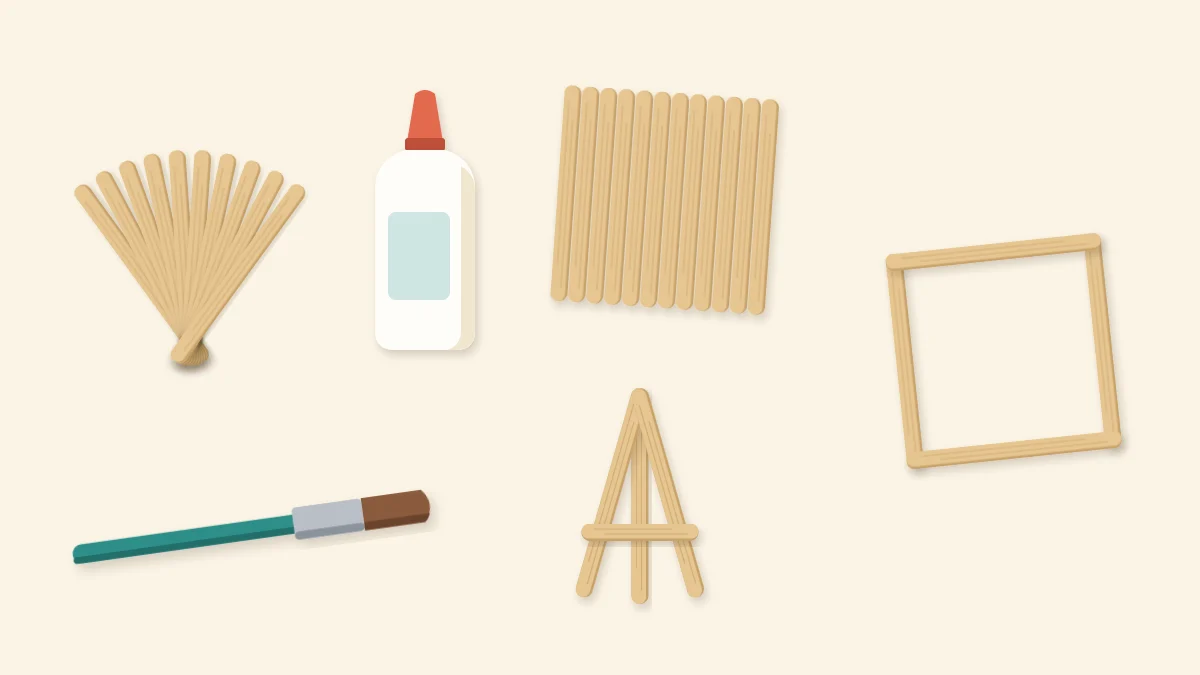
What you need
- One pack of new standard craft sticks
- White craft glue or tacky glue
- Clothespins or small clips and rubber bands
- Pencil and ruler
- Fine sandpaper or an emery board
- Scrap paper and wax paper or baking parchment
Popsicle stick crafts for beginners need very little: a pack of sticks, a bottle of glue and a flat place to work. The sticks are already cut to one length and one width, so most of the measuring is done before you start, and the same handful of techniques builds everything from a coaster to a small model house.
This guide covers the sticks themselves, the short list of supplies worth having, and the four kinds of first project, each of which teaches one skill.
Popsicle Sticks and Craft Sticks Are the Same Thing
The flat wooden stick with rounded ends goes by two names. “Popsicle stick” is the everyday name; “craft sticks” is what is printed on most packs in the craft aisle. They are the same product, usually pale birch, sold in bags or boxes of plain or pre-colored sticks.
Buy new craft sticks rather than washing and saving sticks from frozen treats. New sticks are clean, dry and flat, and a single pack gives you enough matching pieces for a whole project. Saved sticks tend to be stained, slightly bowed from getting wet, and different from one another in length, which makes neat rows hard to lay.
Even a new pack has a few rejects. Set aside any sticks that are bowed, twisted or chipped, and keep them for spreading glue and testing paint.
The Three Stick Sizes
Craft sticks come in three common sizes. The figures below are approximate, because packs vary, so measure a stick from your own pack before you plan anything around it.
- Mini: about 2.5 in (6.4 cm) long. Good for small parts, miniature furniture and short pieces you would otherwise have to cut.
- Standard: about 4.5 in long and 3/8 in wide (11.4 cm x 1 cm), roughly 1/12 in (2 mm) thick. This is the size most projects are written for.
- Jumbo: about 6 in long and 3/4 in wide (15 cm x 1.8 cm). Good for larger frames, plant markers and anything you want to write or paint on.
One fact about the standard size is worth remembering: twelve standard sticks laid side by side are about 4.5 in wide, the same as one stick is long. Twelve sticks therefore make a square, and that square is the starting point for a surprising number of projects.

A Minimal Kit
You can make every beginner project with the items below. Nothing here is specialized, and most of it is probably already in a drawer.
- A pack of new standard craft sticks
- White craft glue or tacky glue
- Clothespins or small clips, and a few rubber bands, for holding joints while the glue sets
- A pencil and a ruler
- Fine sandpaper or an emery board for smoothing rough ends
- Scrap paper to protect the table, with a sheet of wax paper or baking parchment on top so the piece does not stick to it
- A heavy book to press flat pieces while they set
Glue is the one choice that changes how a project goes. White craft glue and tacky glue both hold sticks well; wood glue is worth adding once you build things that have to stand up. The guide to choosing a glue for craft sticks compares them and explains how much to use.
Tip
Lay the pieces out dry before you open the glue. A dry fit shows you a short stick, a bowed stick or a gap while it is still easy to swap a piece.
The Four Kinds of First Project
Almost every popsicle stick project is one of four kinds, or a combination of them. Trying one of each, in this order, takes you from flat work to a piece that stands on its own.
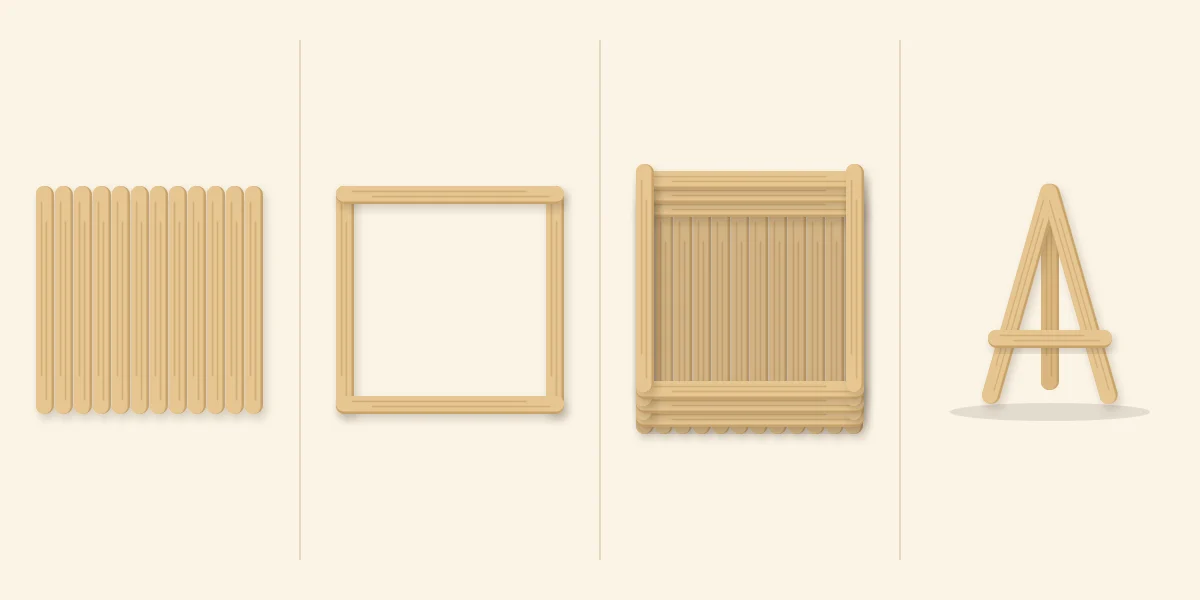
1. A flat panel
A panel is a row of sticks laid side by side and held together by cross sticks glued across the back. It teaches the two habits everything else depends on: lining up edges and using a thin layer of glue. A square coaster made from twelve sticks is the classic first panel.
2. A frame
A frame is four sides around an open middle, joined with overlapped corners, where the end of one stick lies on top of the end of the next. It teaches you to keep corners square, which is harder than it sounds once the glue is slippery. A simple picture frame uses eight sticks and shows the method clearly.
3. A box
A box adds height. The usual method is log-cabin stacking: pairs of sticks laid on alternate sides, layer after layer, on top of a panel base. It teaches patience with layers and how to keep walls rising straight. The site’s lidded box project is the natural next step.
4. A standing structure
A standing piece has to hold its own shape, so its joints carry some strain. A mini easel, built as a small A-frame with a back leg, teaches angles and bracing with only a few sticks.
What Each Project Type Teaches
Stick counts are approximate. Add a few spares to any total to cover the bowed and chipped sticks you set aside.
| Project type | Skill it teaches | Sticks roughly needed |
|---|---|---|
| Flat panel (coaster) | Straight edges, thin glue | About 14 |
| Frame (picture frame) | Square overlapped corners | About 8 to 10 |
| Box (stacked walls) | Even layers, straight walls | Depends on wall height |
| Standing structure (mini easel) | Angles and bracing | Under 10 |
Habits That Make First Projects Go Well
- Use less glue than seems right. A thin, even layer holds better than a thick one, and extra glue only squeezes out and leaves shiny marks.
- Hold every joint. Clothespins, rubber bands or a book keep parts from sliding while the glue sets. Follow the glue label for how long to leave it.
- Wipe squeeze-out right away with a damp cloth or a spare stick. Dried glue shows through paint and stain.
- Sand before you decorate. A few strokes with fine sandpaper take off splinters and help paint go on evenly.
Watch out
When making with children, keep buttons, beads and other small parts away from young children and pets, and have an adult do any cutting of sticks.
Where to Go Next
Start with the flat panel, then the frame. Once both feel easy, you have the two joints that most projects are built from, and a box or a small standing piece is a matter of repeating them carefully.
Frequently asked questions
Are popsicle sticks and craft sticks the same thing?
Yes. Popsicle stick is the everyday name and craft sticks is the name printed on most packs. For projects, buy new craft sticks rather than reusing food sticks, because new ones are clean, flat and all the same length.
What size popsicle sticks should a beginner buy?
Start with standard sticks, about 4.5 in long and 3/8 in wide (11.4 cm x 1 cm). Most projects are written for that size, and twelve of them side by side make a square. Add mini or jumbo sticks later when a project calls for them.
What is the easiest first popsicle stick project?
A flat panel such as a square coaster is the easiest start. It uses about 14 sticks and teaches the two habits every other project relies on: lining up edges and spreading a thin layer of glue. A simple frame is a good follow-up.