Common Popsicle Stick Craft Mistakes and How to Fix Them
Glue blobs, curled panels, split ends and leaning boxes all have simple causes. Here is what each popsicle stick craft mistake looks like, why it happens and how to fix it.

Tutorial at a glance
Most popsicle stick craft mistakes come from the same few habits: using every stick in the pack as it comes, squeezing on too much glue, and moving to the next step before the last one has set. None of them need special tools to fix. They need a slower order of work and a few checks at the right moments.
The faults below are grouped by where they start: in the sticks, the glue, the joints, or the paint and the scissors. Each is described by what it looks like, why it happens and what to do about it.
Four Faults You Can Spot at a Glance
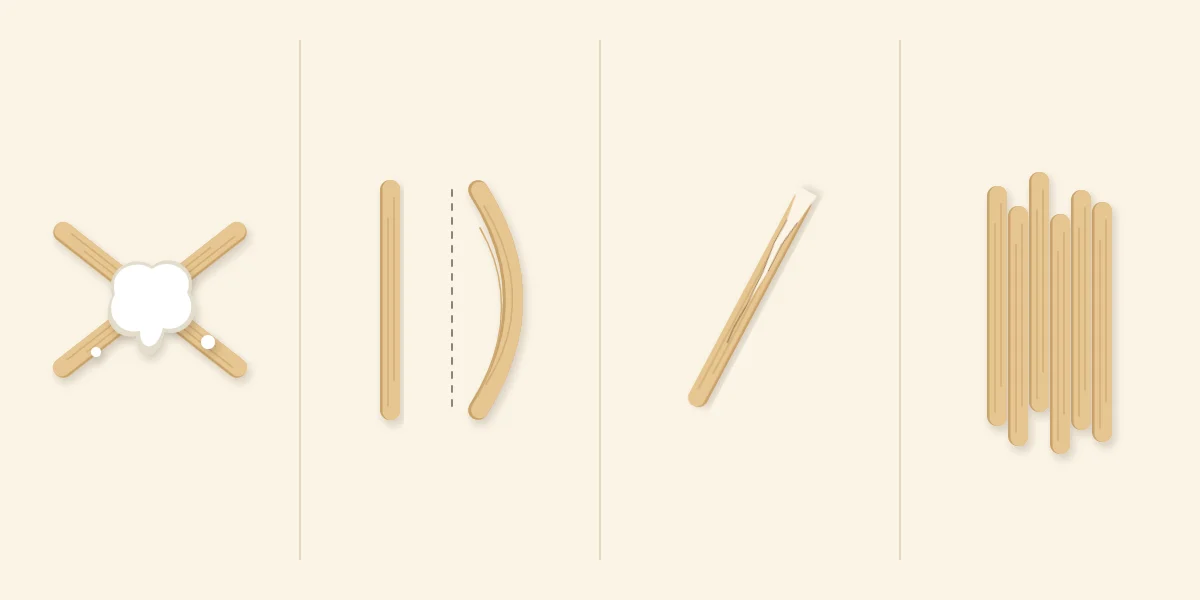
Four problems show up on almost any first project, and each points to a different cause.
- Excess glue. A white blob bulges out where two sticks cross. The glue was applied in a pool instead of a thin line, and the squeeze-out was left to dry. Paint and stain do not cover it evenly.
- A bowed stick. One stick curves along its length, so it lifts off its neighbors or pulls a frame out of line. The stick was curved in the pack and was never checked.
- A split end. A crack runs in from the end of a stick, following the grain. The stick was cut dry, or the scissors were forced through in one hard squeeze.
- Uneven ends. The ends of a panel form a stepped line instead of a straight one. Sticks in a pack differ slightly in length, and they were glued without being lined up against anything.
Sorting Sticks Before You Start
Craft sticks, the name popsicle sticks are sold under, are cut from thin wood, and a pack always includes some that are bowed, twisted or chipped. Using them as they come is the mistake behind most crooked projects.
Sort the pack into three piles before any glue is opened. Roll each stick on a flat table: a straight one rolls quietly, while a bowed or twisted one rocks and clicks. For a second check, draw a straight ink line on scrap paper and lay the stick along it. A gap under the middle shows a bow.
Keep the straight pile for the parts that show and the parts that carry the structure, such as uprights, frame sides and lids. Bowed sticks still work as short cross sticks and hidden braces, where their curve is cut away or held flat. Chipped sticks are good for test cuts and for trying paint colors.

Glue Mistakes: Too Much, Too Soon, No Pressure
Too much glue. A joint needs a thin, even film, not a puddle. Extra glue does not add strength. It lets the sticks slide and leaves squeeze-out to clean up. Apply a thin line, press the sticks together, and wipe away anything that appears at the edges with a damp cotton swab while it is still wet. The guide to choosing between white glue, tacky glue and wood glue covers which one suits which joint.
Moving on before the glue has set. A wall added on top of a wet joint pushes that joint out of line, and the error carries upward through every layer. Build in sub-assemblies instead. Make each panel or frame flat, leave it until the glue has set, then join the finished parts.
No clamping or weight. Glue adds moisture to one face of the wood, and an unweighted panel curls as it dries. Clip small joints with clothespins and cover flat panels with wax paper and a heavy book until they are dry.
Gluing the project to the table. Squeeze-out runs under the sticks and bonds them to whatever is beneath. Work on wax paper or baking parchment, which peel away cleanly.
Tip
Squeeze a small pool of glue onto a scrap of card and apply it with a toothpick or a spare stick. It is easier to control than the bottle.
Joint Mistakes: End to End, No Dry Fit, Out of Square
End-to-end joints. Two sticks glued tip to tip meet on a tiny area of end grain, and the joint snaps at the first touch. Overlap the sticks in a lap joint instead, or bridge the join with a third stick glued across both. The different options are compared in the article on craft stick joints and reinforcement.
Skipping the dry fit. Parts that are glued without first being assembled dry often turn out too long, too short or one stick short of a full row. Lay everything out without glue, check the fit and the count, and only then start gluing.
Building out of square. A frame that looks square by eye is often a slight diamond, and a box built on it leans. Check every corner against the corner of a piece of card or a sheet of paper, and build boxes against a pencil outline drawn on the wax paper.
Paint and Cutting Mistakes
Wet paint on one side. A heavy, watery coat on one face makes that face swell, and the stick or panel cups toward the dry side. Use thin coats, paint both faces, and let the piece dry flat under light weight if it starts to curl.
Forcing a cut. Dry wood split by a hard squeeze of the scissors cracks along the grain. Soften the stick in warm tap water first, close sturdy scissors gradually, and sand the end. Wear eye protection, since offcuts can fly, and have an adult do the cutting when children are involved. The full method is in the guide to cutting popsicle sticks without splitting them.
Problem, Cause and Fix at a Glance
| Problem | Likely cause | Fix |
|---|---|---|
| Cloudy glue blobs | Too much glue | Thin line, wipe while wet |
| Curled panel | No weight, or wet paint on one side | Weight flat, thin coats both sides |
| Leaning box | Bowed sticks or corners not checked | Sort sticks, use a square card |
| Joint snaps | End-to-end gluing | Lap joint or bridging stick |
| Split end | Dry stick, forced cut | Soften, cut gradually, sand |
| Stuck to the table | No protective sheet | Work on wax paper |
Fixing a Piece That Is Already Glued
Stepped ends on a dry panel can be evened by rubbing the whole edge on sandpaper laid flat on the table. Dried squeeze-out can be sanded back gently before painting. A split stick belongs in the test pile, not in a structural spot. A frame that is clearly out of square is usually quicker to rebuild than to correct.
Frequently asked questions
Why do popsicle stick panels curl after gluing?
Glue and paint add moisture to one face of the thin wood, and that face swells while the other stays dry. An unweighted panel then cups as it dries. Cover the panel with wax paper and a heavy book until the glue has set, and use thin coats of paint on both faces.
How can you tell if a craft stick is bowed?
Roll it on a flat table. A straight stick rolls quietly, while a bowed or twisted one rocks and clicks. You can also lay it along a ruled line on paper and look for a gap under the middle.
Can dried glue squeeze-out be removed?
Small beads of dried white or tacky glue can be sanded back gently with fine sandpaper or an emery board before painting. It is easier to wipe squeeze-out away with a damp cotton swab while the glue is still wet. Using a thin line of glue in the first place avoids most of it.